AI-Powered Microbiome Intelligence
Your Microbiome Has a Story.
We Help You Read It.
An AI platform that translates raw DNA from any ecosystem — oceans, soils, the human gut — into scientific narratives, diagnostics, and hypotheses. Integrating all public sequencing data with millions of research papers to generate insight no single scientist could.
A World of Data,
Starved for Insight
Despite the explosion of microbiome sequencing, our ability to extract interpretable insight remains severely limited. Over half a million public sequencing projects exist — yet no intelligent engine can truly read them. The gap between data and understanding is the central bottleneck in microbial science.
Data Without Interpretation
500K+ sequencing projects sit in public databases, but no intelligent engine can read a microbiome sample and extract its meaning. Raw data accumulates; understanding does not.
Expertise Bottleneck
Interpreting a single sample demands mastery of microbiology, chemistry, geology, ecology, and physics. No individual scientist — no matter how brilliant — can integrate it all.
Lists, Not Stories
Current tools produce species tables and abundance percentages — not actionable narratives. Researchers need stories, hypotheses, and recommendations, not spreadsheets.
Years Lost to Pipelines
Scientists spend years navigating computational pipelines, configuring tools, and debugging workflows — instead of focusing on discovery, creativity, and the science itself.
What changes when AI can read your microbiome
| Taxon | Abundance |
|---|---|
| Flavisolibacter ginsengisoli | 12.4% |
| Sphingomonas yabuuchiae | 8.7% |
| Massilia timonae | 6.2% |
| Rhodanobacter lindaniclasticus | 4.9% |
| Burkholderia cepacia | 3.1% |
| ... 847 more taxa |
Ecosystem Analysis: This sample reveals a Flavisolibacter-dominated soil community characteristic of moderately acidic agricultural environments in temperate climates. The high abundance of Flavisolibacter ginsengisoli (12.4%) suggests active organic matter decomposition with potential phosphorus solubilization — a hallmark of nutrient-cycling soils recovering from intensive cultivation.
Hypothesis: The co-occurrence of Sphingomonas and Rhodanobacter at these ratios indicates possible xenobiotic degradation activity, consistent with historical pesticide exposure. We recommend targeted metabolomic analysis to confirm...
From DNA to Discovery
SpokenBiome's AI engine integrates millions of papers with all public microbiome data to generate insight no individual scientist could — turning any DNA sample into a comprehensive ecosystem analysis in minutes, not months.
Sample Collection
Any environment: soil, ocean, gut, skin. DNA is extracted and sequenced.
Microbiome Data Space
Sample is embedded among 500K+ reference datasets, identifying similar ecosystems worldwide.
Knowledge Space
Millions of scientific papers are integrated and a microbial knowledge graph maps which bacteria produce and consume which molecules. Explore it live →
AI Multi-Agent Analysis
Specialized AI agents debate, reason, and synthesize findings from data and literature.
Comprehensive Report
Ecosystem diagnostics, hypotheses, numerical predictions, and actionable recommendations.

Overview of the SpokenBiome framework for AI-guided microbiome interpretation.
New DNA samples are embedded within a Microbiome Data Space containing ~1M samples from oceans, soils, humans, and more — allowing us to contextualize their composition and function against global reference datasets.
These embeddings are then projected into a Knowledge Space that integrates millions of papers from diverse disciplines — including microbiology, ecology, geology, agriculture, and biogeochemistry — creating a unified representation of microbial knowledge.
A large language model (LLM)-guided analysis interprets the retrieved knowledge, combining it with results from parallel pipelines that generate numerical predictions. The resulting output provides ecosystem-level diagnostics and hypotheses, identifying environmental parameters, biotic and abiotic processes, as well as numerical predictions (e.g. farm productivity, carbon content of soils) within a structured report format.
Microbiome Data Space
Every sample contextualized against the planet's microbial history. Your data instantly finds its place among 500K+ sequencing projects from oceans, soils, guts, and every studied ecosystem on Earth.
Knowledge Space
Millions of papers unified into a navigable map of scientific knowledge. Cross-domain connections between microbiology, ecology, geology, agriculture, and biogeochemistry are revealed automatically.
AI-Generated Reports
Not just data — stories, hypotheses, and recommendations. Multi-agent AI systems produce comprehensive ecosystem analyses with executive summaries, environmental context, key findings, and related literature.
See SpokenBiome in Action
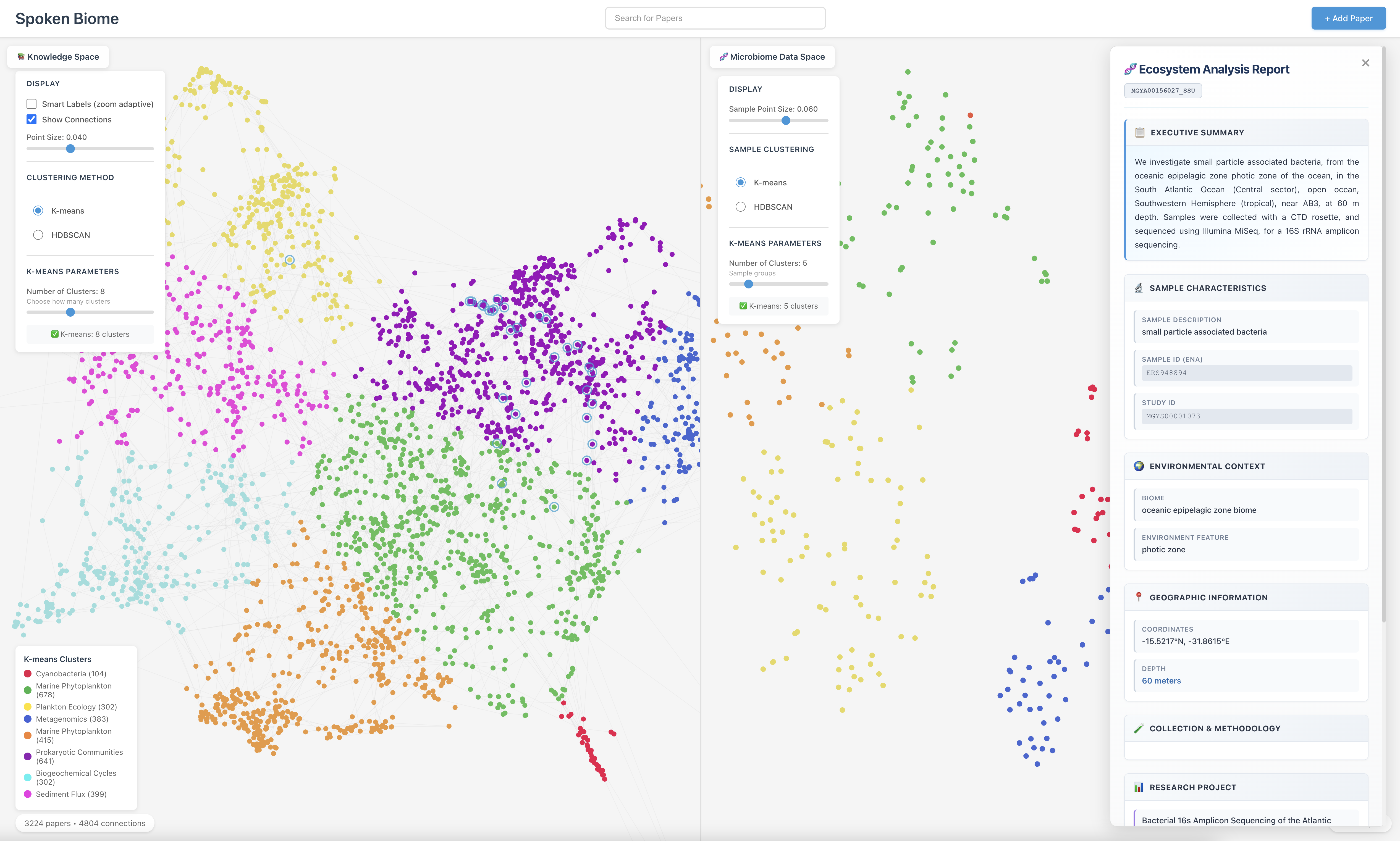
A dual-space interface that lets you explore how your sample relates to ecosystems worldwide, navigate thousands of scientific papers by topic, and generate AI-powered ecosystem analysis reports — all in one view.

Knowledge Space Explorer
Explore thousands of papers clustered by topic. Click any paper to see its abstract and connections to related research across disciplines.

Microbiome Data Space
Visualize how your sample relates to ecosystems worldwide — from ocean bacteria to gut microbiomes, soil communities to coral reefs.
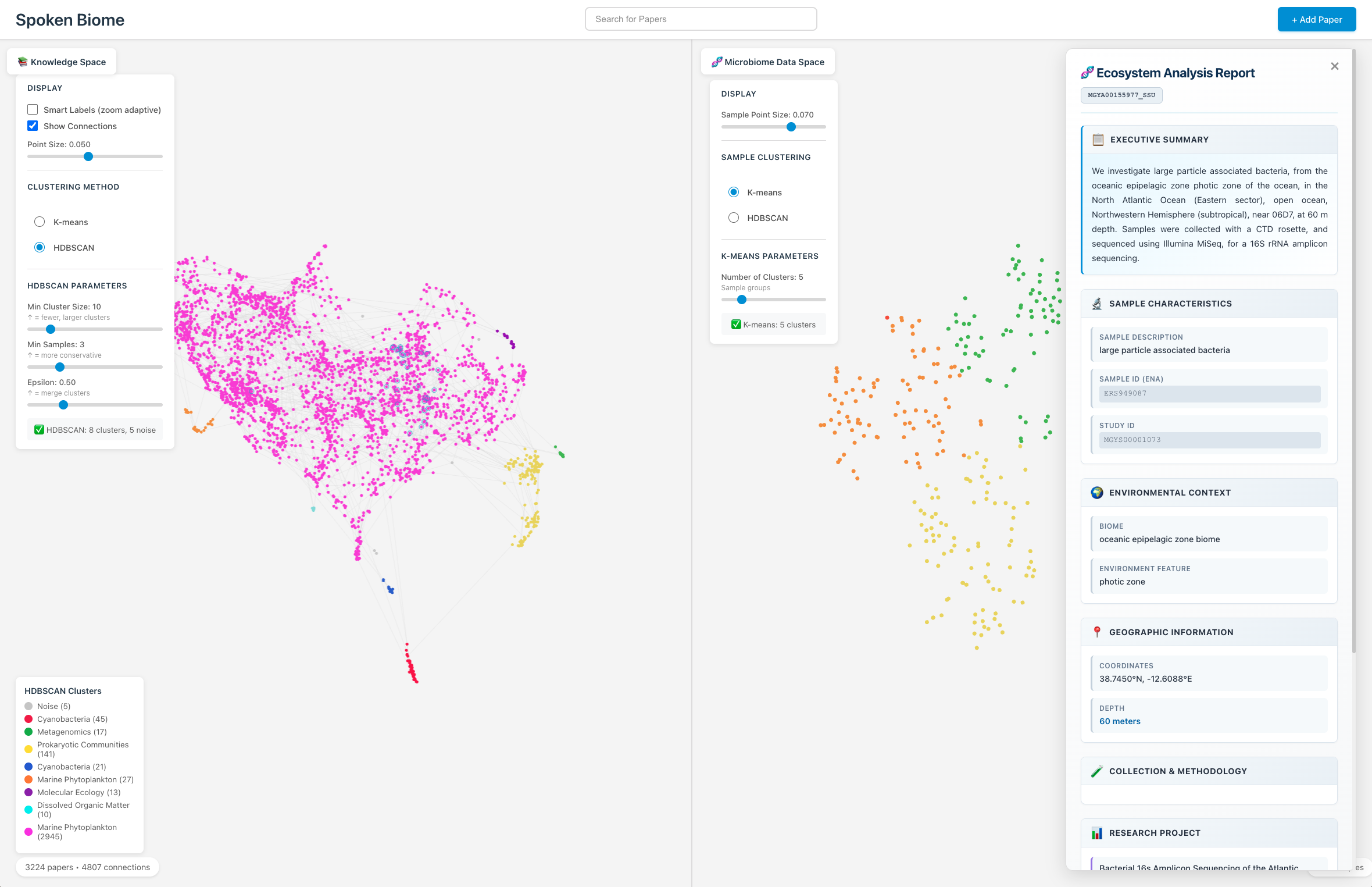
Ecosystem Analysis Reports
AI-generated reports with executive summary, environmental context, geographic information, and key findings tailored to your sample.
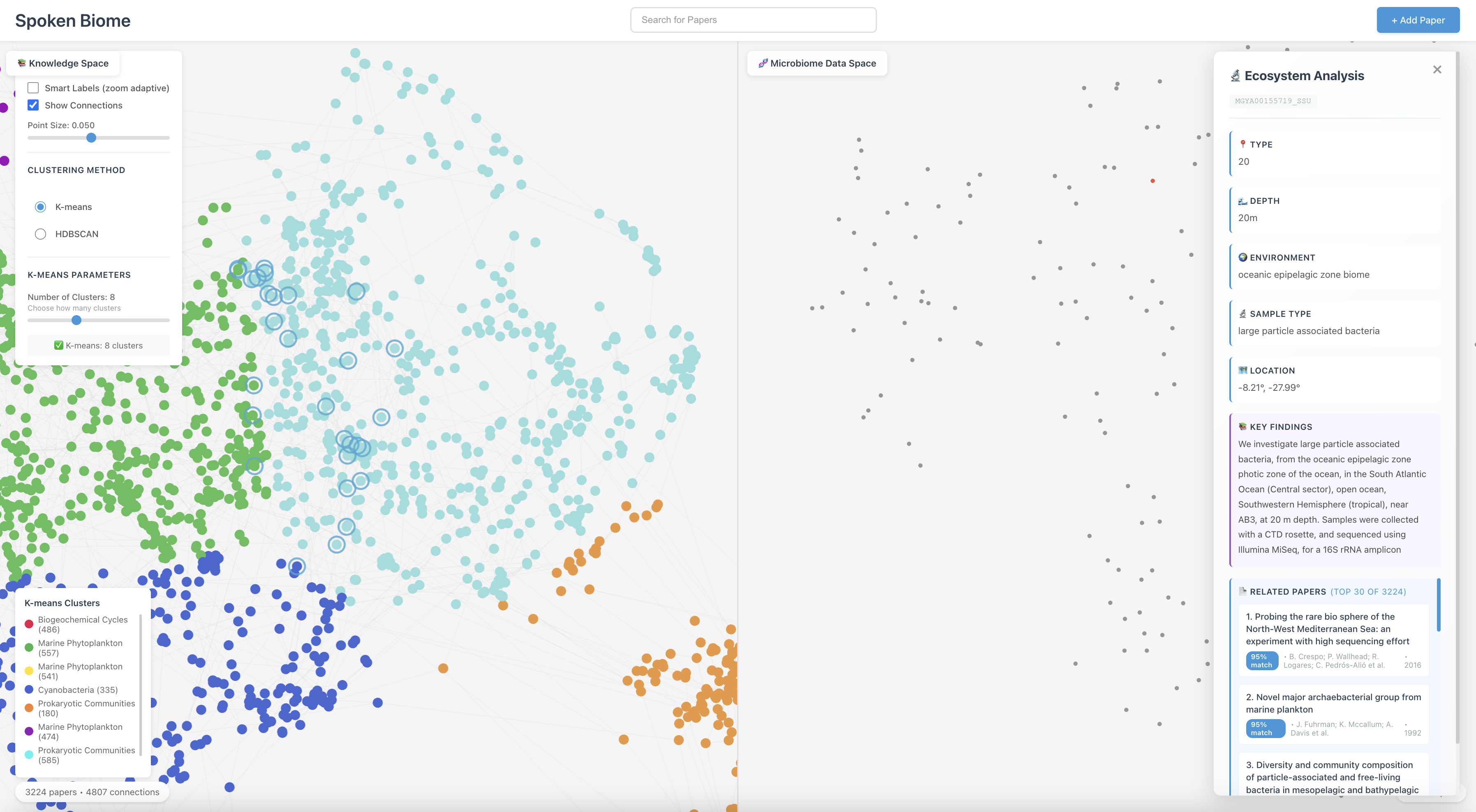
Related Papers & Key Findings
Discover relevant studies and AI-identified insights automatically linked to your sample — no manual literature search required.
The Map of Microbial
Metabolism
An interactive knowledge graph that reveals the hidden metabolic relationships between bacteria and molecules. 799 microbial taxa and metabolites connected by over 1,500 known biochemical interactions — who produces what, and who consumes what — extracted from the scientific literature.
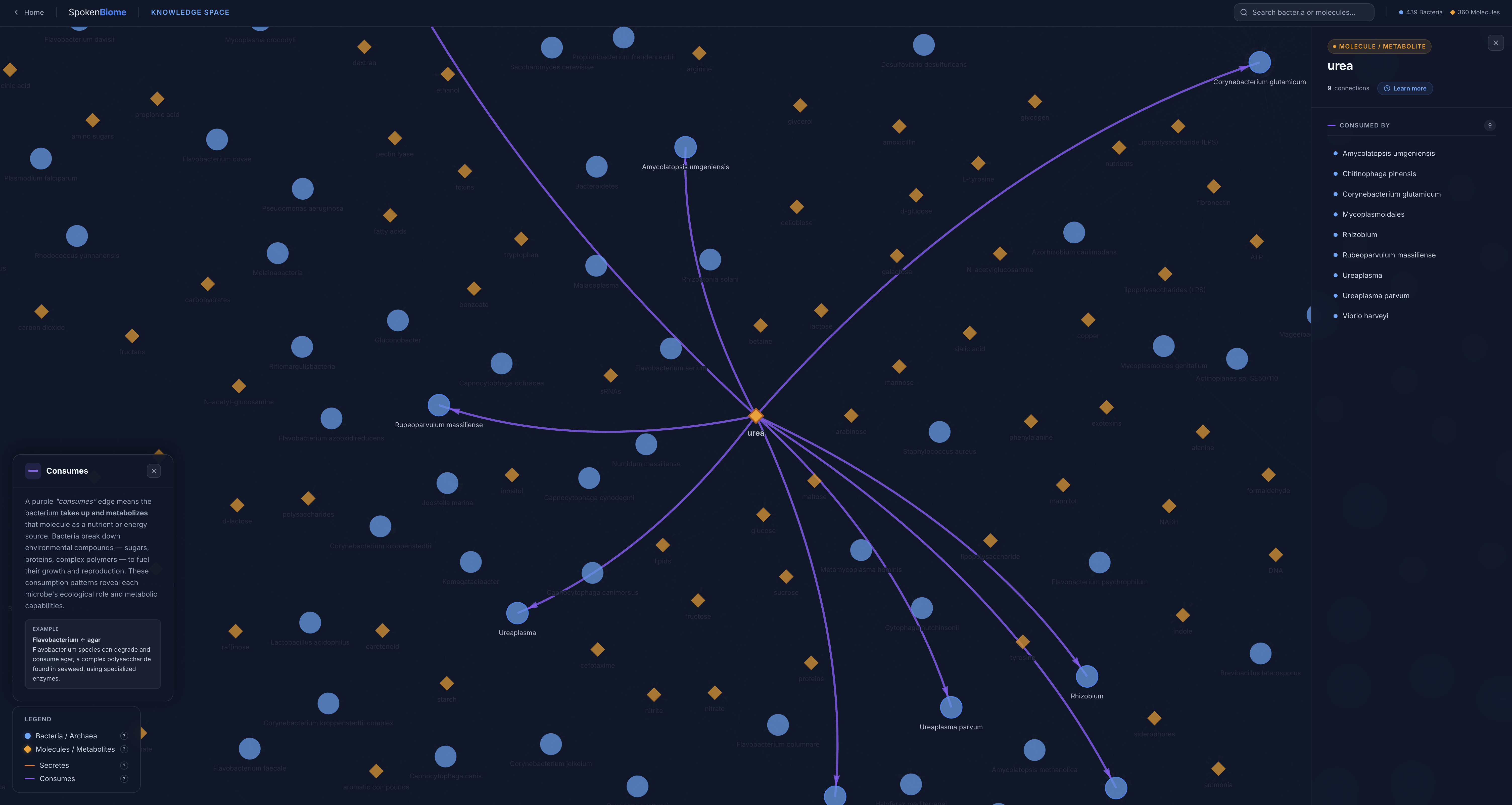
439 Microbial Taxa
Bacteria and Archaea from across every studied ecosystem — soil, ocean, gut, and extreme environments — each one a node in the metabolic network.
360 Molecules
Metabolites, amino acids, vitamins, pigments, antibiotics, and signaling compounds — the chemical language through which microbes shape their environment.
1,500+ Interactions
Every edge is a known biochemical relationship — which organisms secrete or consume which molecules — mined from published literature and curated databases.
Transforming Industries Through
Microbiome Intelligence
SpokenBiome works across every domain where microbial ecosystems matter — turning raw sequencing data into actionable insight for health, agriculture, environment, and fundamental research.
Human Health
From early disease detection to personalized treatment, microbiome monitoring is becoming as essential as blood work — a diagnostic window into your body's hidden ecosystem.
- Early-onset cancer detection through microbiome monitoring
- Personalized drug response prediction based on gut ecology
- Routine microbiome health tracking — like blood tests for your gut
Agriculture
Soil health diagnostics that go far beyond simple scores — understanding the microbial ecosystem that drives fertility, nutrient cycling, and crop resilience.
- Soil fertility diagnostics and optimization strategies
- Nitrogen cycle imbalance detection and correction
- Sustainable farming practice guidance informed by microbial data
Aquaculture & Environment
Water systems and natural environments harbor microbial communities that signal contamination, stress, and ecological health — long before visible symptoms appear.
- Water quality and contamination monitoring
- Ecosystem stress assessment and early warning
- Bioremediation strategy planning based on microbial profiles
Research Acceleration
Let AI handle the computational pipeline so scientists can focus on discovery — generating hypotheses and connections that would take years to find manually.
- Automated hypothesis generation from sequencing data
- Knowledge gap identification across scientific literature
- Cross-domain discovery — connecting microbiology to geology, chemistry, ecology
The Right Moment
This was attempted 10 years ago and fell short. Today's AI is fundamentally different — and four converging forces make SpokenBiome possible for the first time.
AI Agents Understand Science
Today's large language models understand the difference between mathematical expressions, singular and plural scientific terms, and nuanced taxonomic relationships. They can deeply parse scientific meaning — not just match keywords, but reason about biology, chemistry, and ecology.
Multi-Agent Debate
Teams of specialized AI agents can debate hypotheses, cross-check findings, and refine interpretations — mimicking scientific peer review. One agent handles statistical bioinformatics while another reasons over literature, and a third synthesizes the narrative.
DNA Sequencing is Ubiquitous
The cost of sequencing has plummeted. Over 500,000 public microbiome sequencing projects now exist — a global dataset of microbial life. The data is everywhere. What has been missing is the interpretation.
Built by Experts
SpokenBiome brings together world-class expertise in microbiome biology, AI research, and scalable engineering from MIT, IBM Research, and Politecnico di Milano.

Otto X. Cordero, PhD
Associate Professor, MIT CEE · Cordero Lab
Microbial ecologist studying how microbial communities self-organize and function as distributed metabolic systems. Driving the scientific direction behind SpokenBiome.

Mauro Martino, PhD
MIT - IBM Research
Pioneer in AI, data visualization, and human-AI interaction. Advising on the intelligent systems that translate complex microbiome data into comprehensible scientific narratives.

Luca Stornaiuolo, PhD
Toretei.com / Politecnico di Milano
Generative-AI engineer specialised in model training and scalable AI platforms. Building the infrastructure that powers SpokenBiome's multi-agent reasoning pipeline.
Advisory panels in agriculture, aquaculture, public health, environmental chemistry, and biotechnology are being assembled.
The Connective Tissue of the
Microbiome Research Landscape
SpokenBiome exists to bridge the gap between data and understanding — becoming the infrastructure that connects every microbiome sample to the full depth of human scientific knowledge.
Democratize Access
Expert-level microbiome interpretation available to every researcher, clinician, and environmental scientist — regardless of computational expertise or institutional resources.
Transform the Discipline
Turn microbial ecology from a descriptive science into a predictive one — where data-driven hypotheses and AI-generated narratives accelerate understanding of complex ecosystems.
Accelerate Discovery
Compress years of literature review and data interpretation into minutes — empowering scientists to focus on creativity, experimentation, and breakthrough insights.
"If I knew my microbiome data was between good and excellent for the last 5 years, I would be comfortable that I was living a healthy lifestyle, and my probabilities of getting colon cancer would be very low."
— Senior Oncologist, Cancer Research Institute
"If successful, this can change the world — I mean it."
— Otto X. Cordero, PhD
A Research Focused Organization
SpokenBiome is structured as a non-profit, with the core platform freely accessible to researchers worldwide. Revenue from domain-specific commercial applications is reinvested into expanding data, improving models, and strengthening community partnerships — advancing open science through Convergent Research.
Join the Journey
Whether you are a researcher, clinician, potential partner, or funder — we would love to hear from you. Request early access, explore collaboration, or help fund open science.
Email Us
Request Early Access
Be among the first to use SpokenBiome. Upload your sequencing data and receive AI-generated ecosystem analysis reports before public launch.
Partner With Us
Collaborate on domain-specific applications — from clinical microbiome monitoring to agricultural soil health diagnostics and environmental assessment.
Fund the Mission
Support open science through Convergent Research. Your investment advances microbiome intelligence infrastructure for the global research community.